Showing posts with label short story collection. Show all posts

Friday, June 3, 2011

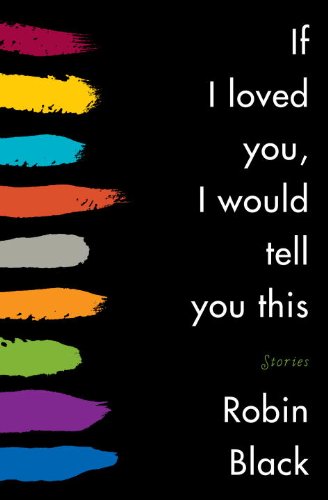
If I Loved You, I Would Tell You This (Robin Black)

By Melanie Yarbrough

Short stories: I can't get enough of them. Last year, I won a copy of Robin Black's collection of stories, If I Loved You, I Would Tell You This from Fiction Writers Review, and it is one of the best collections that I haven't paid for. There are ten stories in this collection, six of which I absolutely loved. This is one of those collections where the title story is definitely the strongest and most haunting. Black's narrator in "If I Loved You, I Would Tell You This" elicits empathy without pity, anger without self-righteousness.

Rating
If I Loved You, I Would Tell You This by Robin Black

Story/ies: 6.0
Like I said, six of these stories I absolutely loved. The other four, however, I felt lacked the rich characters in the other stories. Where structure and experimentation took precedence to character, I felt a little lost and unsatisfied by the end. Luckily, the ratio is 6:4, so I'd say it's a win.

Style: 5.8
Black does not hesitate to experiment, to tell the stories from many different angles, with many different voices. Some of these fall flat, while others fill up to their potential and carried me along to the end of the story when I realized I hadn't breathed since I started. In those, Black's style is strong, melancholic, and self-aware. She stares unflinchingly at the world and tells us exactly what she sees.

General: 6.2
I enjoyed the collection as a whole, despite my affinity for some stories over others. The stronger stories, namely the title story, kept me going and satisfied even when Black's structure or prose fell flat. The best part about short story collections is the ability to move on when one's not particularly working for you, and Black's collection is no different. The stories that worked for me were definitely worth the ones that didn't.

Overall: 6.0

Friday, February 4, 2011

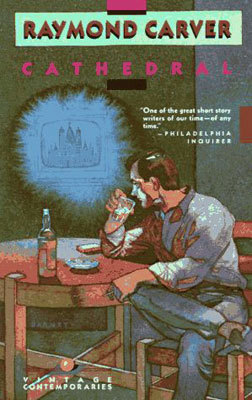
Cathedral (Raymond Carver)

Cathedral is Raymond Carver's fourth short story collection. Though the collection is most famous for its title story, each story reveals Carver's talent and dedication to the ordinary as extraordinary.

Synopsis

If you're unfamiliar with Carver's work or style, I am tempted to ask what is wrong with you. That being said, you have an exciting opportunity to delve into the works of one of my favorite short story writers. His intensity and deceitfully quiet writing never fails to wake me up to the hidden meanings in everyday life or just knock me out of whatever writing slump I'm in at the time. From genuinely funny and charming characters in "Feathers" (one of my favorites) to the eerie sound of a phone ringing in "A Small, Good Thing," Cathedral explores the gamut of human failure and, thus, emotion.

Highlights

It's hard to review a collection of short stories without being tempted to write about each story, which would be tedious and besides the point. Instead I'll highlight some of my favorite stories, ending with the most famous title story that closes the collection.

"Feathers"

Never has a short story made me laugh harder than this one. Carver manages to write about a woman who keeps her old jacked up teeth on a TV, a peacock, and an ugly baby without ever leaving the realm of reality or believeability. The couples in this story aren't perfect; each half of each couple has their flaws and Carver shows them to us not merely to endear them to us, but to explain what lies ahead of them. He hints at a bleaker future, when all of the hope and optimism that they experience in one night has been drained from them. Rather than sucking the joy out of the happiness they do get to experience, however, Carver skillfully displays the ebbing and flowing of life and the futility of trying to guess what's ahead.

"Preservation"

This story strikes me as relevant to the current economic state in America. Though this collection was published first in 1981, the themes and despair in "Preservation" rings true today. There is a universality to hopelessness that transcends time and circumstances, and Carver was a master at relaying that in his stories. The narrator's husband loses his job, and the rest of the story is the slow descent that occurs afterward. The story is strongest in its unexpected moments. The narrator is strong, but not stronger than the forces against and we can't help but watch and wait, guessing which straw will be the one to break her back.

"Cathedral"

In this, one of Carver's most famous stories, there is just as much misunderstanding and miscommunication as in his other stories, but there is an underlying hope that makes it a lighter note to end the collection on. The narrator grapples; there is the understanding of blindness and an attempt, rather than a resignation, to communicate.

Rating

Cathedral
by Raymond Carver

Stories: 10 - This is one of my favorite collections of Carver's stories, as it travels the range of his humor and his despair.

Style: 9 - You can't help but read Carver with the background filter of how autobiographical his writing is. Stories like "Chef's House" and "Where I'm Calling From" hit closer than close to home, and his quiet and honest style resonates long after the story is through.

General: 10 - I'm biased; Carver has played a major role in my growth as a writer, as a reader, and as a writer who reads.

Overall: 9.67 - Take this glowing review with a grain of salt, but only after you've read the collection for yourself.

Friday, February 12, 2010

Stories of God (Rainer Maria Rilke)

LOVES this guy's poetry, and I found this book on the cheap a couple weeks back.

Synopsis

In 1899, Bohemian poet Rainer Maria Rilke—then only twenty-two years old—visited Russia with his close friend Lou Andrea-Salomé, the famous author and psychoanalyst. There he met with great Russian writers like Leo Tolstoy, simple farmers and peasants, and a vast, beautiful landscape. The trip had such a profound effect on Rilke that, upon returning to his home in Munich, he immediately composed Stories of God, a collection of interwoven tales focusing on the role of God and nature in man's life, and published it the following year. Although the collection is now more than a century old, the easy, conversational tone in which it was written allows the book to be read as if the author were living today. Rilke's poetic style is known to be both haunting and lyrical, and this work shows that his prose isn't any different. Stories of God seems to me at least on par with his more famous Letters to a Young Poet, which wasn't published until after Rilke's death. Similarly, the dozen or so stories in this collection foreshadow a depth of vision and insight that the poet would fully develop decades later in his Duino Elegies and Sonnets to Orpheus. Rilke's understanding of the nature of spirituality within mankind is unrivaled, and each scene provides further evidence of this mastery.

What really struck me about the book, though—aside from the beautiful lyricism and seamless interweaving of each story—lies in the implications of the title: Stories of God. Not Stories of Christianity or Stories of Religion or even Stories of Faith, but Stories of GOD. Rilke takes the idea of a divine presence and strips it of everything that can be traced back to any one faction or creed. The God of this book is a personal one, whom the narrator knows intimately but has never met. The simple setting and straightforward telling of each tale—usually by the narrator to a friend or passing acquaintance—allow the scope of the collection as a whole to broaden significantly. That isn't to say that the impact of these stories are in any way diluted, however. Stories of God is in fact a hub that is accessible through almost any avenue of spirituality. Take for example this conversation between the narrator and a gravedigger that takes place in "A Tale of Death with a Strange Postscript:"

Suddenly, seized by a powerful revulsion, I said, "Why are you doing that?"
The gravedigger continued to smile. "It is a living," he said, "and then, too, most people do the same as I do, don't you agree? They bury God up there the way I do people here." He pointed up at the sky and explained to me, "That's a big grave too. In the summer wild forget-me-nots grow on it—"
"There was a time," I interrupted him, "when people buried God in heaven, that's true."
"Has that changed?" he asked with a strange sadness.
"At one time," I continued, "everyone did throw a handful of heaven over Him, I know that. But at that point He actually wasn't there anymore, or maybe He was..." I hesitated.
"You know," I started up again, "in olden times, people used to pray like this." I spread my arms out and felt my chest involuntarily expand.


From here, the narrator goes on to tell the gravedigger a "fairy tale" about God trying to inch heaven closer to earth. Many of the exchanges in Stories of God follow this same pattern of discussion: the narrator asks a friend or neighbor a seemingly benign question; the friend or neighbor replies in a way which surprises the narrator; the narrator is then reminded of a story that is in some way about God. The narrator also often requests that the listener retell the tale to any children he or she may know, which is fitting, since most of these stories read more like fables, anyway. It's that feeling of ancient wisdom that usually accompanies the writings of someone like Aesop or Confucius that makes Rilke's collection truly come alive. "The Tale of God's Hands," for example, which begins the book, concludes with the moral that "without God there is no completion," as His hands discover when they try to create things on their own. Rilke helps us to understand the importance of this "completion," but is able to avoid much of the cynicism and trepidation that accompanies more direct discussions of faith or religion. The book may have been written very early in Rilke's own life, but Stories of God is a collection that is sure to have a profound effect on readers of all ages.

Rating

Stories of God
by Rainer Maria Rilke

Story—8.17
Rilke uses simple characters that appear in most cultures to great effect, breaking down the collection into a series of connected vignettes that easily could have taken place in almost any part of the world.

Style—8.67
The voice of this collection is consistent and accessible, but alarmingly profound. Nothing is preached or overstated, and the stories never feel contrived. I would believe it if someone told me that these are actual fables and folk tales passed down from generation to generation in Germany.

General—8.33
Stories of God is highly enjoyable, and very easy to get into/through, but doesn't have too much drive. It's easy to pick the book up, take what you want from the first few stories, and then walk away. Each individual story wraps up rather nicely, so it isn't very hard to put it down anytime.

Overall—8.39


Rilke is a great writer, I hope you guys pick him up whenever you can. Keep reading, Genoshans!
Contact Information and FTC Disclaimer

FTC Rules: While I do not make any money from authors, publishers, or anyone else related to these books in exchange for these reviews, there have been times where I've received free copies of a book to be reviewed, and may receive more in the future. Due to FTC compliance rules, however, you should always assume that I have an ulterior motive, and thank them for their unceasing vigilance in the face of this ever-increasing threat of blog advertising.

If you would like to contact me regarding a book you would like reviewed, or for writing matters in general, feel free to email me at bpmcgackin@gmail.com