Showing posts with label memoir. Show all posts

Friday, July 8, 2011

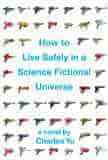
How to Live Safely in a Science Fictional Universe (Charles Yu)

by Thom Dunn
I've been looking forward to reading this book since I first heard about it prior to its release last year. I was already familiar with Yu's short story collection, Third Class Superhero, and I enjoyed his dry humor, his simplistic approach to complicated scientific situations, and his complicated scientific approach to simple situations. Unfortunately, How to Live Safely in a Science Fictional Universe proved to be quite the popular book, and I had difficulty getting my hands on a copy until recently. I rarely approach a modern novel with a full year's worth of hype behind it, so I was increasingly worried about how disappointed I might feel after finally reading it.

Lucky for me, How to Live Safely in a Science Fictional Universe quite lived up to all of my expectations.

The premise of the book is absolutely delectable: Charles Yu (the character, not the author) is a time machine mechanic with a Masters degree in Applied Science Fiction. He spends most of his life in his time machine along with his non-existent dog, Ed, who was retroactively removed from continuity but, like all good dogs, still provides his master with unconditional love despite this paradox of causality. He will readily tell the long, possibly detailed story of not meeting The Woman I (he) Never Married. And so on. Charles Yu embarks on a quest to reconnect with his father, during which he accidentally shoots his own Future Self, who gives him a book called How to Live Safely in a Science Fictional Universe, which is (or, more accurately, will be) written by Charles Yu (the character — wait, no, the author — oh, whatever).

That should pretty much tell me exactly what to expect from this book — ridiculous, self-referential, incredibly clever nerd humor disguised as ridiculously convoluted techno-babble. Charles Yu uses time travel as a means of exploring language, grammar, and the construction of our own memories. Don't be scared off by all the talk of Closed Timelike Curves and wormholes — even when he rambles on about technical terms you don't understand, he does so in an entertaining, tongue-in-cheek manner:

The base model TM-31 time machine runs on state-of-the-art chronodiegetical technology: a six-cylinder grammar drive built on a quad-core physics engine, which features an applied temporalinguistics architecture allowing for free-form navigation within a rendered environment, such as, for instance, a story space and, in particular, a science fictional universe.

Or, as Mom used to say: it's a box. You get into it. You push some buttons.

In many ways, How to Live Safely in a Science Fictional Universe can be seen as a successor to Slaughterhouse-Five by Kurt Vonnegut. Both tell psuedo-autobiographical stories (at least, stories initially inspired by personal histories) through the veil of time travel and other silly tropes of science fiction (fully acknowledging their own absurdities). This gives the author a chance to look at his own (fictionalized) life from the perspective of an outsider. Some of my absolute favorite parts of the story are when Charles Yu uses complex quantum physics (including some made-up psuedo-physical story terms) to discuss his relationship with his father, and the emotions that surround that relationship, as they offer a unique but undeniably sympathetic angle on the situation, something you don't often find when using technical science to explain how you're feeling.

Rating
How to Live Safely in a Science Fictional Universe, by Charles Yu

Story: 8.0
While the basic story doesn't stray so far from the established tropes of time travel science fiction (paradoxes, timeloops of cause-and-effect, etc.), Charles Yu still manages to create a unique and distinctive fictional world, one that is fully conscious of its own fictional nature but never loses its heart. The characters and situations are as absurd as they are endearing, and almost make you wish that you could live in a science fictional universe with them. But it's the meticulous plotting of such a(n intentionally) convoluted mess that is particularly impressive; Yu manages to spin his readers into a cloud of wacky metaphysical concepts and weird science, but never gets lost himself.

Style: 9.6
Cosines, physics equations, and chronodiegetical substrates have never been so hilarious or easy to understand. Charles Yu writes with an incredibly unique voice, exploring otherwise bizarre and emotionless situations with the raw heart and wonder of a child. The humor is subtle and dry and wildly clever, but the reading feels quick and easy.

General: 9.4
How to Live Safely in a Science Fictional Universe is one of the most touching and entertaining books I've read in a long time. If you like humor, read it; if you like stories about father-son relationships, read it; if you like science, read it; if you like science fiction, read it; if you like memoirs, read it. It even manages to use all of those incredibly-clever-but-not-really-anymore-because-duh tropes of metafiction (like writing the story you're reading while you are reading the story that's being written) and makes them feel fresh and enjoyable, and actually have a greater resonance in the story as a whole. While some people might be put off by its seemingly esoteric (or just plain weird) nature, give this book a chance; I don't think you'll regret it.

Overall: 9.00

Friday, May 6, 2011

Art and Madness (Anne Roiphe)

by Melanie Yarbrough

Up until recently I've always been a strictly-fiction girl. But after a brief dry spell of creativity and reading inspiration, I decided to ask the powers that be what to read next (read: The Daily Beast). And lucky for me, Liesl Shillinger wrote about Anne Roiphe's most recent memoir, Art and Madness:

Reading Anne Roiphe’s riveting memoir of her tumultuous twenties, Art and Madness, written in a tone of Didion-like detachment, but saffroned with her distinctive, pungent regrets and her curious humility, I marveled at her depiction of George Plimpton’s Paris Review parties in the early 1960s, on the Upper East Side, near Manhattan’s East River. Thirty years later, I had gone to those parties, in those same rooms, when I was the age she was then. They did not resemble the bacchanals she remembers. For a while, I almost envied her. She describes “the heavy air of flirtation, the perfume of illicit sex that wafted through the book-filled rooms of George’s apartment,” and the power games played by the male guests, “the famous men or the would-be-famous men flexing their skills, strutting their stuff, talking of agents and publishers and rights to this or that.”
After reading Roiphe's enthralling account, I felt the same way.

Synopsis

One of the downsides to memoirs like Roiphe's are the poor schmucks like myself who read it and romanticize the Golden Age of writing. I've been doing the same thing as I read Raymond Carver's biography by Carol Sklenicka; naively overlooking the depths of alcoholism, adultery, and poverty to wish that I could live in an era where creative writers - creative minds - could be as adored and sexualized as in the olden days.

But Roiphe is steadfast in her seeming quest to quell any of those romantic ideas. She is brutal. Her past relationships and decisions are far from pretty; they are neither justified nor justifiable. She does not make excuses, instead she admits to giving up on her own writing in pursuit of her first husband's success. It's a frightening tale to read, as a writer myself, especially as a writer who has been struggling lately with the balance of life and the pursuit of a writing career. Roiphe remembers a time when she forgot herself: "I had to learn that muses can be fired or dismissed but writers either do or don't write without permission or encouragement from anyone."

The way she talks about her daughter, her affairs, and how she struggled with love and sex and growing up show life in its messiest of states, the sandpaper underbelly of the creative life.

Rating

Art and Madness by Anne Roiphe
Story: 9.0

While it's difficult to judge the "story" of someone's life, the tales Roiphe tells are intriguing and revelatory. There is not one wasted sentence. From walking through the snow carrying her husband's typewriter even after her water breaks (yes, that water) to multiple affairs including with the founder of The Paris Review, there aren't many dull moments. Even for those not interested in romanticizing the old world of writers, Roiphe has come out surprisingly whole after a difficult road, an inspiring story for anyone trying to recognize themselves again.


Style: 7.5

Shillinger compares Roiphe's style to Joan Didion in her review of the book, and I would have to agree. Roiphe is succinct without being exclusive; she tells you the whole story with a detachment that strips the sometimes heartbreaking parts of distracting emotion. She gets right to the point of the realities of her situation and their consequences. There are lessons without imposed morals.

General: 8.0

While my reasons for reading this memoir may seem a little sick - exploiting another woman's journey in the world of writers to substitute my own lack of revelry - the experience was very different than I intended. Roiphe glares at her past and, thus, so does the reader. Aside from the scandalous moments, the heart of her story is about a woman, a writer, who gave up her passion for writing and lived a difficult period of time for it. No one will fight for what you want, especially if you give it up so easily.

Overall: 8.2

I'd say this is a must-read for aspiring writers everywhere, or anyone who's given up something they felt defined them. Roiphe gives a great description for the feeling of being undefined.

Thursday, July 23, 2009

TIMEQUAKE: A Guest Post

*With our head Genoshan off wandering the streets of San Diego (probably dressed like Rocket Raccoon), he's handed the reins of the kingdom over to me for the week, so here goes...something, anyway.

You're sick, now you're better, there's work to be done — Kilgore Trout

The final novel published by acclaimed Absurdist/Sci-Fi author Kurt Vonnegut (followed only by a collection of essays and short stories), Timequake is inherently a failure. Don't get the wrong idea here; Timequake was actually the first Vonnegut I ever read (when I was about 12 — boy, did that go over my head! Why did you buy this for me as an Easter present, Dad?), and I enjoyed it even more the second time around (when I could actually comprehend and appreciate it), but the book Timequake is constructed entirely around Vonnegut's inability to complete the novel Timequake to a satisfactory degree.

Confused? Don't worry about it. Vonnegut's metafictional conceits have metafictional conceits, which in turn have more metafictional conceits, but not in that hurts-your-head kind of way; no, Vonnegut is clearly having fun with this, in that quirky, self-conscious way he does so well. And fortunately, he lays it all out on the line for the reader right up front, to avoid any unnecessary confusion: Timequake was (originally) a novel in which the universe suffers from a crisis in self-confidence—should it go on expanding? What's the point?—and forces everyone within it to re-live the last 10 years of their lives. Everyone would retain their memories of the first 10 year go-round, but would still be forced to go through them again on autopilot, reliving every moment precisely as it happened the first time, unable to change a thing.

Eventually, Vonnegut mostly gave up on this idea, and the Timequake that was ultimately published transformed into a different creature. The book consists of part salvaged sections from the original novel—presented as such, and usually concerning Vonnegut's fictional literary alter ego, Kilgore Trout—and part personal memoir. Taking the notion of a Timequake and applying it to his own personal experiences, as well as to the personal experiences of those close to him, Vonnegut explores ideas of fatalism, determinism, and human nature in the modern world through this fascinating (and often quite comic) lens. These anecdotes range from tragic (a woman who accidentally paralyzes her husband, and must relive it through the quake) to triumphant (a man wrongly imprisoned but eventually released and exonerated who must relive his entire redemption arc to become a hero again) and everything in between, narrated with that delightfully sardonic wit for which Vonnegut has become so renowned.

That being said, Timequake tends to eschew most of the traditional conventions regarding plot and linear cohesion, and this might turn some people off from it. Vonnegut does eventually return to many of his (and Trout's) briefly touched upon anecdotes and stories, often giving us small, almost stream-of-consciousness bursts of information before moving on to something only tangentially related and eventually working his way back several chapters later, but one gets the feeling that it never really goes anywhere. Each anecdote or story has a beginning, middle, and end, and the thematic connections are typically clear, but the story as a whole lacks an arc. As a reader, you are drawn in not by the ongoing meta-adventures of Kilgore Trout, but by the sheer enjoyment of each story as conveyed by Vonnegut (or Trout); there is very little beyond that, however, to compel you to turn the page and continue.

But this isn't necessarily a bad thing. The end of the novel is surprisingly uplifting, and Vonnegut does flirt a bit with the massive destructive forces of Ennui and Apathy (the true antagonists of the story) that overcome the human race once they are free from the grasps of the Timequake (this would have been the action-packed, heroic climax of the original Timequake, in which Kilgore Trout must wake the people up and urge them to continue living, etc., etc.), which all kind of resembles a plot. Surprisingly enough, the apparent lack of cohesion almost makes it easier to read, as most of the anecdotes are both brief and enjoyable. As a reader, you never quite know where it's going to take you next, and a large part of the enjoyment is seeing where all of these seemingly non-sequitur characters and concepts lead and intersect. For those of you entirely unfamiliar with the works of Kurt Vonnegut, a large part of his appeal lies in his ability to speak simply about the most profound things, and this book is certainly no exception. There are times when his language and sentence structure feel almost childlike, but the concepts and ideas contained within are enough to blow your mind all the way to Tralfamadore, to Dresden, or to somewhere else entirely.

I give Timequake 3 and a half out of 5 Vonnegut self portraits:


So it goes.

Saturday, March 28, 2009

A Heartbreaking Work of Staggering Genius (Dave Eggers)

I'm a day late, but only because I was out of town. I'm still counting this as regularly scheduled.

Synopsis

I need to stop reading nonfiction. I loved this book, and think that, while not perfect, it is a stunning depiction of the insanity that accompanies everyday life, but a lot was lost on me as a reader who generally doesn't take to nonfiction as strongly as fiction or poetry. See, this is a memoir by a young man who lost both of his parents to cancer just before he finished college, and who then had to take care of his seven-year old brother. That's the synopsis, but it tells you almost nothing about this book. Dave Eggers basically just speaks to the reader—and sometimes himself—for 400 pages, and it's great. It's refreshing, it's honest, it's down to earth. During the acknowledgments, which are hilarious and prelude the book very well, Eggers actually tells readers to think of the book as a work of fiction if it makes it easier for them, or if they don't like reading nonfiction. I liked that suggestion, it being one of the many instances that Eggers breaks the fourth wall and is hyper self aware, but despite how good most of the writing is, it doesn't exactly work that way. The writing is remarkable, phenomenal, keeps you so engaged. Every time you begin to pull back from the story a little, or think something is a little contrived, a little absurd, Eggers agrees, and remarks on how contrived and absurd the situation is, how he doesn't believe it himself, how he's probably remembering incorrectly or possibly even lying. The voice of the narrator is astonishingly conversational, but in the end, that's almost one of the problems. A Heartbreaking Work of Staggering Genius is fresh, it's wonderful, it's all these amazing things, but to be honest it also gets kinda boring. There were parts of this book where Dave Eggers was blowing my mind with how aware he was of what I was thinking, where my head was in terms of his writing, the story, the characters. I couldn't believe how accurate he could be. But there were other times when I honestly didn't really care at all, and only kept reading out of a dull sense of curiosity, not wanting to drop it in case there was some mesmerizing ending I'd be missing. There are times when Eggers is so honest that you almost hate him, and think that he really is a horrible person, and how can he treat his brother that way, which I think takes a lot of guts and a great deal of skill, but in a memoir, with no real plot, no real direction, it can leave the reader without any sense of why they're reading.

I enjoyed this book immensely. The things about it that were good were soooooooo good, but it took me a while to read, not because I didn't want to, but because it was so anecdotal. It jumps back and forth between time and location and mindset and all of these real things that the mind does while a person is driving along the Pacific Coast Highway so excited to play frisbee at the beach but what if we just drive off this cliff and I think we would make it we would probably make it just climb out the car windows and jump right before we hit the water but if we didn't make it what would happen and would a lot of people come to my funeral? would Sarah come to my funeral? oh man Sarah is so hot I should call her what a catch she was I haven't seen her since my mom died. Four hundred pages of that is easy to put down sometimes. And it's hard because there isn't always a real reason to pick the book back up. There are so many emotions, so many things to connect to, so many real moments, but I never found myself thinking, "I can't wait to get back to that book and find out what happens next!" Maybe that's just the product of it being a memoir, but I feel like memoirs can still have plot, drive, direction, story arcs. Life has story arcs sometimes. A big part of the book is the fact that Dave and his brother don't really have all that much to do. They're free. It's not a road trip book, or a story of self-discovery and overcoming tremendous adversity, or fulfilling one's dreams. It's a story about getting by, and how the author felt about getting by. Again, this might just be my reaction as someone who isn't a huge fan of nonfiction, and I did enjoy this book, I highly recommend it for a number of reasons, but I was expecting a little bit more than a unique and erratic narrator. It slows down a lot as you go further and further in and things begin to be repeated. Motives blur, characters jumble together, gain and lose significance. In this way it truly is evocative of real life, since you never really know what's going to happen, or who is still going to be important to you five years down the line, and I applaud that kind of truthfulness, but I wanted to see more of a journey, and I didn't get that.

Rating

A Heartbreaking Work of Staggering Genius
by Dave Eggers

Story—6.5
We never really get to connect with any of the characters. Some recur, some don't, and we never get a good feel as to why. There's a lot of "we've been friends forever" but never any reason why certain people are more important than others. Some of the characters that are present throughout the entire book are never even described, just introduced by name and then referenced repeatedly.

Style—9.2
So ridiculously original to me. Maybe someone else has written a memoir that's this erratic, this true to life, this close to the way I feel the human mind tends to work, but I've never seen it. I have to give Eggers credit for the strength of his ability to write brilliant narration.

General—7
Some people are going to think this is the most incredible book ever written. Some are going to think it's self-serving garbage. I can understand where both are coming from, but am myself stuck somewhere in the middle. It had its strengths, it had its weaknesses. A solid effort.

Overall—7.57


If you have any suggestions or requests for books to be reviewed, or would like to write a guest review yourself, remember you can always email me at bpmcgackin@gmail.com, subject line "TDG: Review Suggestion" or "TDG: Guest Reviewer." I would love to get more people involved and see what the rest of the world thinks about some of these books!

Contact Information and FTC Disclaimer

FTC Rules: While I do not make any money from authors, publishers, or anyone else related to these books in exchange for these reviews, there have been times where I've received free copies of a book to be reviewed, and may receive more in the future. Due to FTC compliance rules, however, you should always assume that I have an ulterior motive, and thank them for their unceasing vigilance in the face of this ever-increasing threat of blog advertising.

If you would like to contact me regarding a book you would like reviewed, or for writing matters in general, feel free to email me at bpmcgackin@gmail.com